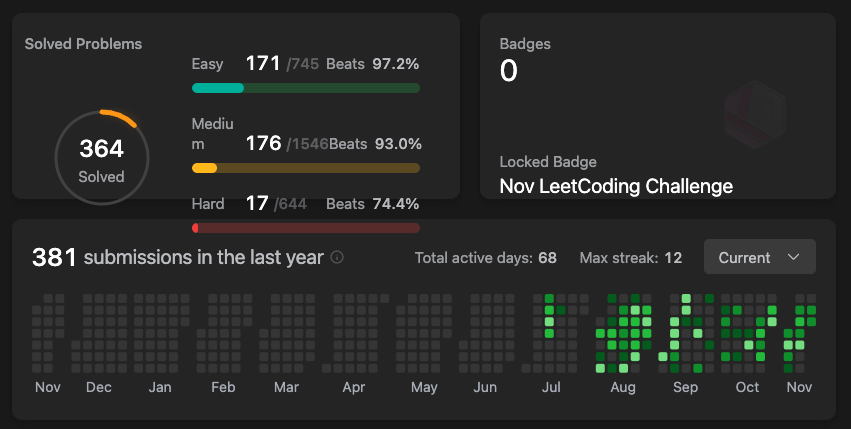
My Leetcode stats
(my languge of preference is python and c++)

I am a Software Engineer (ML)u. I have previously worked at Meta in the monetization AI team and in SEI Investment in their AI team . I hold a Masters in Computer science, with a concentration in machine learning from NYU Courant institute of mathematical sciences (which I completed in May 2023) and an undergrad degree in computer science from Delhi college of Engineering (which I completed in 2021). I have relevant internship experience working at Intel, Optum and various research labs. I have taken part in verious hackathons, optum stratethon, CERN webfest to name a few. I have had my work published in various conferences (see resume for details). I have won various accolades such as International Maths Olympiad, Nutanix women in tech award, National talent search examination (NTSE scholar). It was the excitement of uncharted territories that propelled me to pursue a career in technology, with a vision to solve real world problems and be a part of the development of impactful, scalable and sustainable solutions. That is, as the japanese like to call it my ikigai.
My favorite languages for machine learning, software engineering, and data science.

My preferred technologies for web development and database.








My preferred technologies for machine learning and its applications.
My favorite tools for version control, code editing, and container orchestration.

Built a production-ready Multimodal RAG System supporting 3 document formats (PDF, DOCX, TXT) plus images with 2 embedding models (Sentence Transformers for text, CLIP for images). Delivered 3 integration interfaces: REST API via FastAPI, CLI tool, and Python SDK. Implemented ChromaDB vector database for similarity search, enabling semantic retrieval across multimodal content and cross-modal queries (text-to-image search). The system provides end-to-end infrastructure including document processing, embedding generation, and vector storage, deployable for document Q&A, knowledge bases, and content recommendation use cases.
Check it out!
Built an anti-doomscroll detector with 2 functional versions: a standalone OpenCV application and a Streamlit web app. The system uses MediaPipe for real-time 3D head pose estimation via webcam, tracking pitch angle against a calibrated neutral position to detect downward phone-gazing. Triggers alarm video automatically after 3 seconds of continuous detection. Enhanced the base head-tracking with experimental AI vision integration using Ollama's LLaVa model for screenshot analysis, enabling smart detection of actual social media usage beyond simple head position monitoring.
Check it out!
Built a production-grade LLM training framework in PyTorch implementing 15+ core components across the complete modern language model pipeline. Delivered transformer architecture with 4 advanced features (multi-head attention, RoPE embeddings, RMSNorm, SwiGLU activations), KV caching system achieving 10x inference speedup, and Mixture-of-Experts layer with dynamic routing. Engineered 4 training optimizations: gradient accumulation, mixed-precision training, checkpointing, and LR scheduling. Implemented 3-stage alignment pipeline: supervised fine-tuning with masked causal modeling, reward modeling with Bradley-Terry loss, and 2 RLHF algorithms (PPO with value head and GRPO with group-relative baseline), both with KL-divergence regularization for frontier AI lab-grade alignment capabilities
Check it out!
I built a multi-agent critiquing system that implements collaborative reasoning where multiple AI agents debate and refine solutions through iterative critique cycles. The system includes three different reasoning approaches (basic, advanced, and multi-agent) with JSON-logged results comparing their performance on complex reasoning tasks. The engineering work involves orchestrating multiple LLM agents to challenge each other's outputs, implementing debate protocols for consensus-building, and benchmarking whether collaborative critique improves solution quality over single-agent reasoning. This explores emergent intelligence through agent interaction —a key research direction for improving LLM reasoning capabilities. It is able to run 120+ agents concurrently.
Check it out!
Fine-tuned Mistral-7B on Jane Austen's complete works using LoRA, processing 1,726 instruction-response pairs from 8 novels to replicate 19th-century prose and dialogue patterns. Achieved parameter-efficient training by modifying only 0.19% of model parameters (13.6M out of 7.2B) while maintaining full fine-tuning quality. Optimized for 16GB GPU deployment (Tesla P100) using 2 techniques: gradient checkpointing and FP16 mixed precision. Built custom data pipeline converting JSONL datasets into instruction-following format, enabling the model to generate Austen-style conversational responses with period-appropriate formal dialogue and social dynamics.
Check it out!
Developed a machine learning model and using decision tree, Support Vector Machine, logistic regression, random forest and KNN techniques further supplemented XGBoost and Catboost to enhance their performance to predict whether or not a woman had PCOS disease or not. Self collected the data from various sources (WHO etc ) and cleaned it.
Check it out!
Developed a machine learning model and using decision tree, Support Vector Machine, logistic regression, random forest and MLP techniques further supplemented XGBoost to enhance their performance to detect whether or not a site is a phishing site or not. Self collected the data from various sources (Phishtank, UNB etc ) and cleaned it while extracting 3 key features from data.
Check it out!
Developed and designed a hate speech detection system hosted on Flask and using Multinomial naive Bayes, Support Vector Machine, logistic regression, random forest and KNN techniques further supplemented by AdaBoost. It further makes the process of hate speech detection streamlined and can be used for silencing Youtube comments which are hateful.
Check it out!
Detected Cheating in Online Chess matches using CNN - LSTM with an accuracy of 89% on a self curated dataset of 90,000 games Conceptualised nomenclature based on player reaction time per move with a special emphasis on sacrifices and mating sequences to streamline detection and improve response time by 30%
Check it out!
Analysed financial news articles with a Mining-based hierarchical classifier using 4 Performance Indicators (lagging, lagging reverse, leading, directionality) with positive and negative dictionaries for sentiment analysis. Classified the same by assigning a rating of good, bad and neutral with an accuracy of 93%, 90%, 86% respectively
Check it out!
Performed analysis using Hadoop MapReduce, chaining, secondary sorting, joins, binning, summarization and filtration patterns. Also made use of Apache Pig to perform some analysis along with Mahout for recommendations.
Check it out!
Built thread-safe communication protocol} for real time traffic simulation using mutexes, locks, and message queues
Check it out!
Developed a real time PDF intake chatbot using tensorflow which is contextually aware, which uses huggingface transformers and is deployed on streamlit. Also tried different architectures, such as seq2seq, distilBERT etc. The PDF ingestion just takes 0.1 seconds, which shall increase the knowledge transfer by a huge margin.
Check it out!
Predicted the Mother-To-Child Transmission Ratio using Linear Regression in the years 2030 and 2045 and analyzed expenditure of countries between 2008 to 2015 using Clustering (HAC) and consequently predicted Spain's expenditure via Support vector regression for administering ART to pregnant women and kids. Data was collated from 5 different sources such as WHO, UNICEF etc.
Check it out!
Vid-synchronize is a real-time online video synchronization platform with chat functionality which allows remote users to host, and watch videos synchronously in user created rooms.
Check it out!
Forecasted travel claims using MLP (without address data imbalance, with SMOTE and SMOTE coupled with Adaboost) on 11 key parameters with an accuracy of 78%, 90%, 93%
Check it out!
Detected driver drowsiness using OpenCV for blink detection and statistics
Check it out!
Detected fake reviews using SVM and multinomial naive Bayes were chosen as classifiers, and model tuning was done using two distinct vectorizers, Count Vectorizer and TF-IDF Vectorizers. Overall, all of the trained models had an accuracy rate of 80%, indicating that the vectorizers functioned admirably and that there are distinctions between false and actual reviews. Out of the two, the count vectorizer improved the models' performance more, and , LR performed the best, with an accuracy rate of 85% and a recall rate of 92%.
Check it out!